
Automation that can double production without a single new press
A five-minute stop is easy to miss in the moment. But a thousand five-minute stops show up in the statistics. AP&T is now rolling out a new control system in which machine learning helps the line find its own optimal rhythm – part of a broader initiative in which AP&T aims to help manufacturers get significantly more out of their existing press lines.
When the economy weakens, it becomes difficult to justify major investments in new press lines. But the need to increase productivity does not disappear. On the contrary. For many manufacturers, the answer is already on their own factory floor, in the form of lines that can perform considerably better with the right automation and, above all, proper integration.
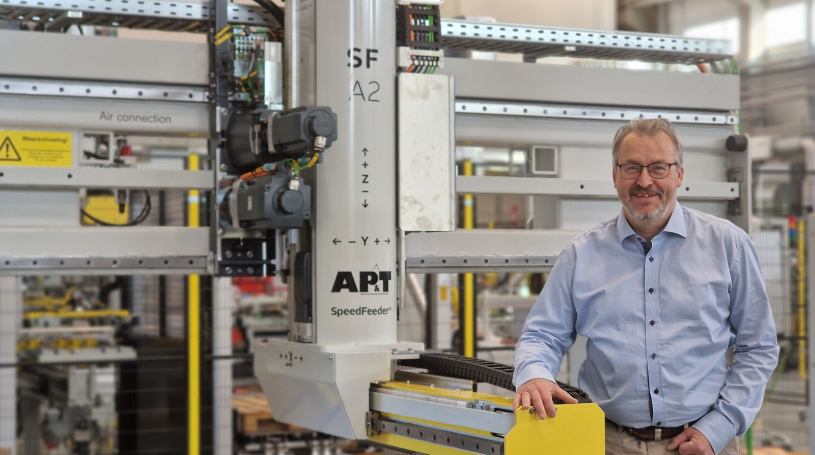
“We see it again and again: customers who have become blind to what their existing lines are capable of. But with the right automation and integration, we can often double their output using the same presses they already have in place,” says Jörgen Theander, Product Manager Automation at AP&T.
Automation is the muscle – integration is the brain
AP&T has operated in the sheet metal forming industry for more than 60 years and has developed one of the market’s broadest automation portfolios. Its transfer and tandem solutions are used in everything from press hardening to the production of heat exchanger plates. But Jörgen Theander is careful to distinguish between two things.
“We usually say that automation is the muscle, but integration – that’s the brain. Because that’s where real value is created. That’s where we make sure all parts of the line work together in the best possible way,” he says.
That is also why AP&T works closely with its customers, often for several decades, and why the company always develops simulations and cycle time calculations before a customer makes a purchasing decision. For AP&T, it is about creating confidence: showing the customer exactly what they will get and then delivering those results. And it really does not matter where the presses in the line come from – regardless of manufacturer, AP&T integrates them with its automation and takes full responsibility for the entire line system and its performance.
No catalog sales
“We’re not catalog salespeople. We define the challenge together with our customer. Based on our proven, standardized premium equipment, we then develop a solution that is adapted and tailored to how the customer wants their production to work,” says Jörgen Theander.
That approach differs from many integrators in the market, which are often focused on solving a specific task in the production process, meaning documentation, service, and long-term support can vary significantly. AP&T instead takes an overall responsibility that extends far beyond the point when everything is in place.
Jörgen Theander describes the first step with a new customer as “a walk through the factory.”
“We review the big picture, look at how much inventory there is, what the production flow looks like, and identify the bottlenecks. If they have a lot of semi-finished material waiting between stations, that is a sign that production is not fully connected. Then we can help find a solution that reduces that kind of tied-up capital and gets throughput moving. And that naturally gets the customer’s business moving as well.”
A control system that learns on its own
A major technical development is the new control system that AP&T is in the process of implementing for its automation. The system has the capacity for more dynamic functions and offers expanded production engineering capabilities. Above all, however, it will be able to optimize its own cycle using machine learning, in which the system validates each cycle and ensures that the machine runs fast where it should run fast, and slow where that is best. In this way, wear and downtime are reduced while reliability increases.
“For our customers, it is about eliminating costs and reducing tied-up capital. With the economy the way it is, production needs to become smarter – not just faster,” says Jörgen Theander.
Part of that involves what Jörgen Theander calls “system thinking,” in which AP&T brings the holistic perspective of large line systems into smaller solutions as well. With pedagogy, logic, and a detailed overview, the company makes it easy for the operator to dig into what is happening in the line and what needs to be adjusted to improve production.
Cycle times cut in half with existing presses
Exactly how much impact the right automation and integration can have is evident in the case of PVI Esskå, a supplier to the Swedish automotive industry. The company kept its existing hydraulic presses but had AP&T replace the presses’ control systems and install new automation equipment. As a result, cycle times were cut in half and production capacity increased by around 500 hours per year.
An important part of AP&T’s way of working is focusing on user-friendliness and on minimizing micro-stops – small interruptions that may seem insignificant on their own but together consume a large share of production time. And although AP&T’s equipment may have a higher purchase price than some alternatives, Jörgen Theander believes that is far too narrow a way to compare them.
“When you look at total cost of ownership, we are significantly lower because our solutions are well thought out and efficient. It is about tradeoffs – using the right machines and building the right solutions, not just buying the cheapest option,” he says.
Strong potential in Europe and the U.S.
AP&T sees strong potential in Europe, but above all in the U.S., where many manufacturers still run manual or semi-automated processes with many human handoffs. Even lower-volume manufacturers are segments that can benefit from AP&T’s solutions, because the automation concept can be packaged cost-effectively regardless of production size. Among industries, AP&T points to the home appliance industry as an area where manufacturers have not yet reached their full production potential.
“That is part of our One Responsible Partner promise. No matter what the solution looks like, we never leave our customer hanging. We make sure that what we deliver truly fulfills what we have promised. That is the most important thing of all,” says Jörgen Theander.
无需新增压机,自动化即可使产量翻倍
单次五分钟的停机在当下很容易被忽略,可是上千次五分钟的停机就会在统计数据中显现。目前,AP&T正推出一套全新的控制系统,利用机器学习帮助生产线自主找到最佳运行节奏——这是AP&T更广泛计划的一部分,旨在帮助制造商显著提升现有压力机生产线的产出。
当经济低迷时,要为新的压力机生产线做出重大投资变得困难。但对提高生产效率的需求并未消失,反而更加迫切。对许多制造商而言,答案其实就存在于自己的工厂车间:通过配备合适的自动化和尤为关键的系统集成,现有生产线的性能可大幅提升。
AP&T自动化产品经理Jörgen Theander表示:“我们一再看到这样的情况:客户忽视了现有生产线的实际潜力。但只要采用正确的自动化和集成方案,我们通常就能将客户现有压力机的产量翻倍。”
自动化是肌肉——集成是大脑
AP&T在钣金成形行业已深耕超过60年,并开发了市场上最广泛的自动化产品组合之一。其多工位解决方案和串联解决方案被广泛应用于从热成形到换热器板片生产的领域。但Jörgen Theander谨慎地区分了两者:
“我们常说自动化是肌肉,但集成是大脑。因为真正的价值创造正是集成。我们通过集成确保生产线的所有环节以最佳方式协同工作。”
这也是为什么AP&T与客户长期紧密合作,往往持续数十年的原因,以及为什么公司总是在客户做出采购决策之前就开发仿真模拟和计算节拍时间的原因。对AP&T而言,关键在于建立信任:让客户清楚看到他们将获得什么,然后交付这些成果。而且,生产线中的压力机来自哪个品牌并不重要——无论制造商是谁,AP&T都能将其与自动化系统集成,并对整条生产线系统及其性能承担全部责任。
非目录式销售
“我们不是靠目录销售的产品商,而是与客户共同定义挑战。基于我们经过检验的标准化高端设备,然后开发出一个可根据客户生产需求、量身定制的解决方案。”Jörgen Theander表示。
这种做法与市场上的许多集成商不同,后者往往专注于解决生产过程中的某个特定任务,因此在技术文件、服务和长期支持方面可能存在较大差异。AP&T承担的总体责任远远超出了设备交付时的范围。
Jörgen Theander将与新客户合作的第一步描述为“工厂实地走访”。
“我们审视全局,查看库存量、生产流程现状,并确认瓶颈所在。如果工位之间积压了大量半成品,那就意味着生产未实现完全衔接。这时我们可以帮助找到一个解决方案,以减少此类资金占用,提高生产率,这自然就会使客户的业务更高效的运转起来。”
可自主学习的控制系统
AP&T 正在为其自动化系统实施一项重大的技术革新——全新的控制系统。该系统具备更多的动态功能,并提供可扩展的生产工程能力。但最重要的是,它能通过机器学习自主优化运行节拍:系统会验证每个生产周期,确保设备在需要高速运行时提速,在适宜时则放慢速度。由此,在提升可靠性的同时还减少了磨损和停机时间。
“对客户而言,这关乎降低成本和减少资金占用。在当前经济形势下,生产需要变得更智能,而不仅仅是更快。”Jörgen Theander说道。
这其中的一部分涉及Jörgen Theander所说的“系统思维”,即AP&T将大型生产线系统的全局视角也融入到小型解决方案中。通过教学式的设计、清晰的逻辑系统以及全面的概览,公司可以使操作员能轻松掌握生产线的运行状况,并明确需要调整哪些环节以提升生产效率。
利用现有压力机将节拍时间减半
正确的自动化和集成能带来多大影响,从瑞典汽车行业供应商PVI Esskå的案例中便可一目了然。该公司保留了现有的液压机,但委托AP&T更换了压力机的控制系统并安装了新的自动化设备。结果,节拍时间缩短了一半,年产能增加了约500小时。
AP&T工作方式中的一个重要方面是关注用户友好性和最大限度减少微停机——即那些单独看来微不足道、但累积起来会占用大量生产时间的小规模中断。尽管AP&T设备的采购价格可能高于某些替代方案,但Jörgen Theander认为,仅以价格的方式进行比较过于狭隘。
欧美市场的巨大潜力
AP&T在欧洲看到了巨大潜力,而且尤其看好美国市场,因为许多制造商目前仍采用人工或半自动化流程,并存在大量大量人工交接环节。即使是小批量制造商,也能从AP&T解决方案中获益,因为其自动化方案无论生产规模如何,都能以经济高效的方式进行配置。在各行业之中,AP&T 特别指出家电行业尚未充分发挥其生产潜力。
“这正是我们‘可靠的合作伙伴’承诺的一部分。无论解决方案如何,我们绝不会让客户陷入困境。我们确保交付的产品真正兑现我们所承诺的。这是最重要的一点。”Jörgen Theander表示。
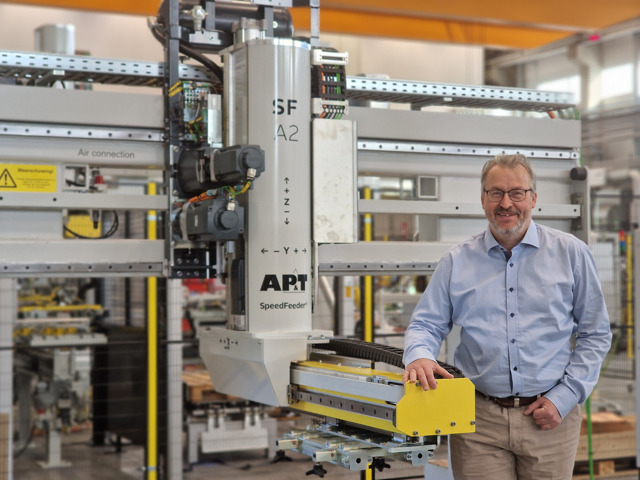
通过合适的自动化和集成,AP&T自动化产品经理Jörgen Theander及其团队通常能够帮助客户使用现有的压机实现产量翻倍